
Get answers to common questions about the Law Enforcement Levy
Ballot Measure 22-212, the Linn County Law Enforcement Levy, can be confusing. Sheriff Michelle Duncan has put together answers to the common questions she has received. See them below, and feel free to submit more below in our Contact Us form at the bottom of the page.


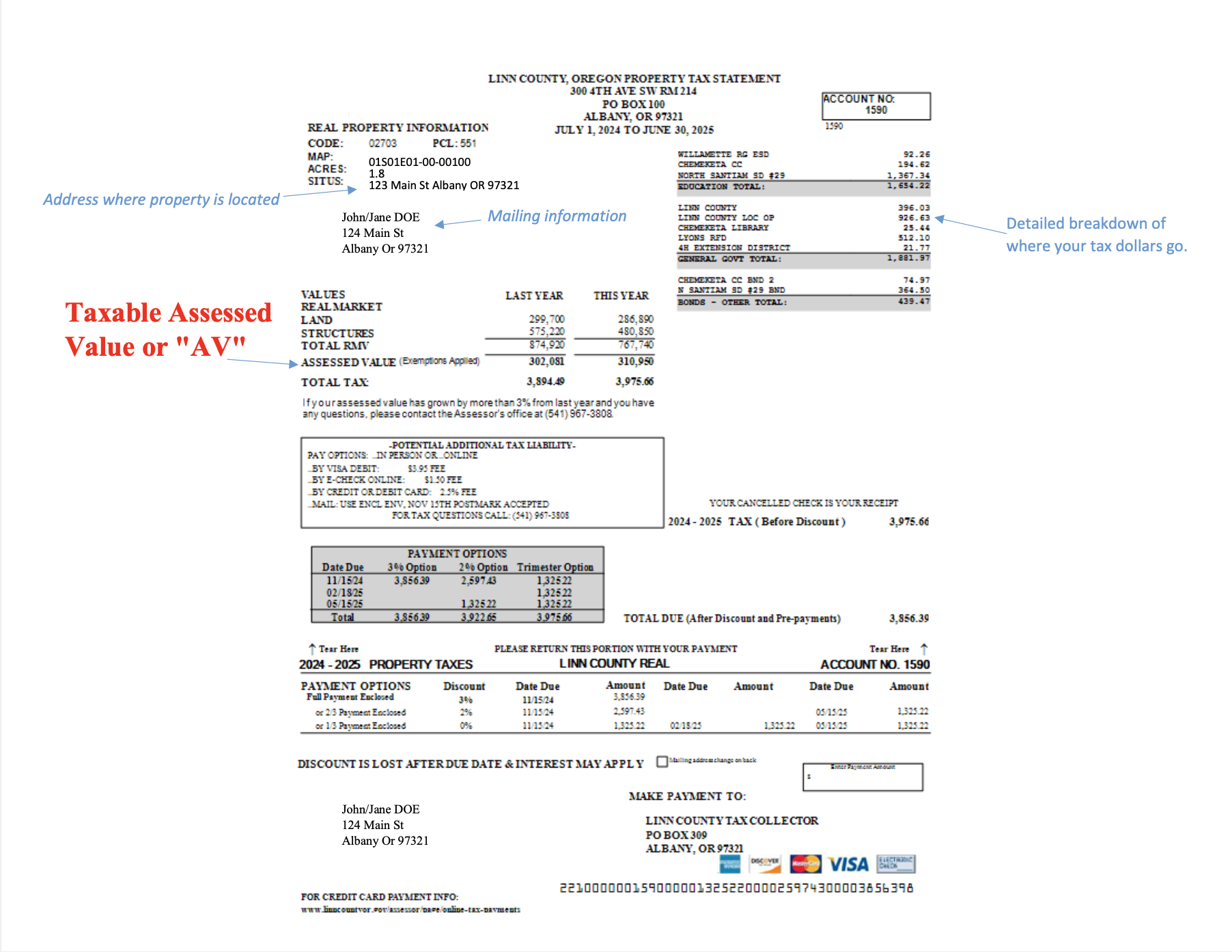
How much will the levy cost me? Where do I find my taxable Assessed Value?
The Assessment and Taxation Office is responsible for assessing all properties in Linn County. This includes commercial, industrial, residential, farm, forest, manufactured structures and business personal property. Each October property tax statements are distributed to property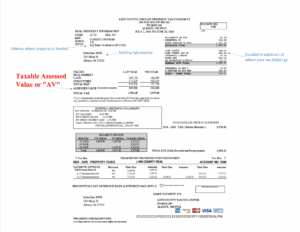 owners. To find your taxable assessed property tax value, you can click on our helpful guide, as well as search for your property online.
- Find the assessed property tax value either on your tax statement at the link below:
- Linn County Assessed Property Values – Property Search
- Click on Public Account Detail Search
- USE OUR HELPFUL CALCULATOR, or
- Divide the assessed property tax value by $1,000
- Write down this number
- Multiply that number by $2.98 to calculate what you are currently paying for the Linn County Law Enforcement Levy.
- Now, multiply that number instead now by $3.08 to calculate what the rate on Ballot Measure 22-212 would cost for the Law Enforcement Levy.
- The difference between the two numbers is what the proposed levy tax would raise for your property.
Is this an additional levy, or replacing the expiring levy?
The current Law Enforcement Levy EXPIRES on June 30, 2026. The proposed levy will REPLACE the expiring levy, and begin July 1, 2026 should it be approved by the voters.
There is no overlap between the two levies.
Does the Albany Police Department receive funding from this Linn County Law Enforcement Levy?
It is a common misconception that the “Linn County Law Enforcement Levy” funds all law enforcement agencies in Linn County. However, that isn’t the case.
Neither the Albany Police Department, nor Lebanon Police or Sweet Home Police Departments, receive funding from Ballot Measure 22-212. They are funded through their own City budgets, and supporting levies that are different than Ballot Measure 22-212, and voted upon only by citizens within their own cities. All citizens in Linn County who are registered to vote can vote on Ballot Measure 22-212.
What is the General Fund?
The General Fund is the primary operating fund supporting Linn County governmental operations like the County Assessor’s Office, Surveyor’s Office, County Clerk, Board of Commissioners, and many other county departments. The Sheriff’s Office, like other county departments and offices, received a small portion of the General Fund, that coupled together with other funding sources and revenue allow for the full operation of the organization. The General Fund resources from the County, allocated by the Budget Committee and the Commissioners, makes up 12.9% of the Sheriff’s Office budget.
It is worth noting the Permanent Tax Rate (set in place in 1997 by Measure 50) for Linn County is $1.2736 per $1,000 of assessed property value. This is the fifth lowest rate of all 36 counties in Oregon. Click the graphic to see the full chart.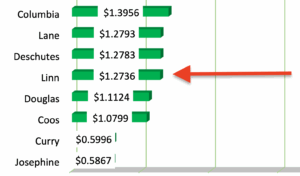
Does the money levied go to the Linn County General Fund?
No. Money raised by Ballot Measure 22-212 can only be used for purposes presented to the voters – to support law enforcement operations for the Sheriff’s Office, prosecutions at the District Attorney’s Office, and programs and detention services overseen by the Juvenile Department.
If Ballot Measure 22-212 passes, how would it affect my property taxes?
The current law enforcement levy is at the tax rate of $2.98 per $1,000 of assessed property value “AV” (this is different than the real market value “RMV”). If passed, the proposed levy would increase the rate to $3.08 per $1,000 of assessed property value, an increase of $0.10 per $1,000 of assessed value “AV”.
For a home with an assessed property value of $250,000, the YEARLY cost to fund and support law enforcement in Linn County would increase $25.00.
What percentage of the Law Enforcement Levy goes to the Sheriff's Office, District Attorney's Office, and Juvenile Department?
The Linn County Law Enforcement Levy has been a shared tax levy between the Sheriff’s Office, District Attorney’s Office and the Juvenile Department for a very long time. The revenue from the levy is split in the following way: 76% supports the Sheriff’s Office, 14% helps operate the Juvenile Department, and 10% assists the District Attorney’s Office budget.
Which historical measures limit property tax revenue in Oregon?
In Oregon, voter-passed measures that limit property tax revenue include Measure 5 (1990) and Measure 50 (1997). Together, they have shaped Oregon’s property tax landscape by controlling tax rates and limiting increases in property values for tax purposes.
- Measure 5 (1990) – This measure established limits on the total amount of property tax revenue that can be collected for local governments and schools. The effect was to reduce the overall property tax burden for residents and limit the amount of money local governments could raise through property taxes. It created tax rate limits for different types of property:
- $15 per $1,000 of real market value for education (K-12 and community colleges).
- $10 per $1,000 of real market value for non-education purposes (such as police, fire, and other local government services).
- Measure 50 (1997) – This measure further limited the amount of property tax revenue by capping the maximum taxable value of property. This measure significantly changed the way property taxes are calculated in Oregon, establishing a system where property taxes are based on assessed value rather than real market value, and limiting how much property taxes can increase year-over-year:
- It froze the assessed value of property at its 1995 value, adjusting it for inflation, up to a 3% increase annually.
- It reduced the tax rate to $5.00 per $1,000 of assessed property value for education and $10.00 per $1,000 of assessed property value for non-education purposes (when combined, this gives the maximum property tax rate of $15.00 per $1,000 of assessed property value).
How would the tax revenue be used for Law Enforcement in Linn County?
This levy maintains, and enhances, existing public safety services, with revenues funding operations of the Sheriff’s Office (76%), criminal prosecution at the District Attorney’s Office (10%), plus juvenile offender supervision and detention with the Linn County Juvenile Department (14%).
The proposed levy would provide funding for Linn County’s law enforcement services, and would maintain the following:
- 24-hours per day uniformed Patrol and criminal investigations operations;
- Prosecution of major crimes, including homicides, as well as crimes against children, sexual assaults, and property and person crimes;
- Victims’ assistance for all crime victims;
- Juvenile programs reducing crime;
- Operation of 252-bed Jail facility.
If passed, proposed measure 22-212 would:
- Support continued operations of the 252-bed Linn County Jail facility
- Provide funding to renovate and upgrade the female housing unit in the Jail, as well as the 9-1-1 Communications Center for Linn County
- Increase the availability and capacity of digital forensic services and technology available to investigate and prosecute high-tech crimes
- In partnership with mental health professionals, increase mental health crisis response capabilities and trained personnel, as well as connect those persons in crisis with mental health and medical assistance
- Promote Emergency Preparedness initiatives county-wide related to wildfires, flooding and severe weather events through disaster planning, prevention and mitigation efforts
- Continue the Sheriff’s Office involvement in an inter-agency drug enforcement team to arrest drug traffickers and those involved in serious drug-related crimes such as identity theft, property crimes, child abuse and child neglect
If the proposed measure 22-212 does not pass, the proposed services would not be provided and the tax rate would not change.
Is there a short informational guide to the Law Enforcement Levy to download?
Download our informative single page guide to the Linn County Law Enforcement Levy, Ballot Measure 22-212.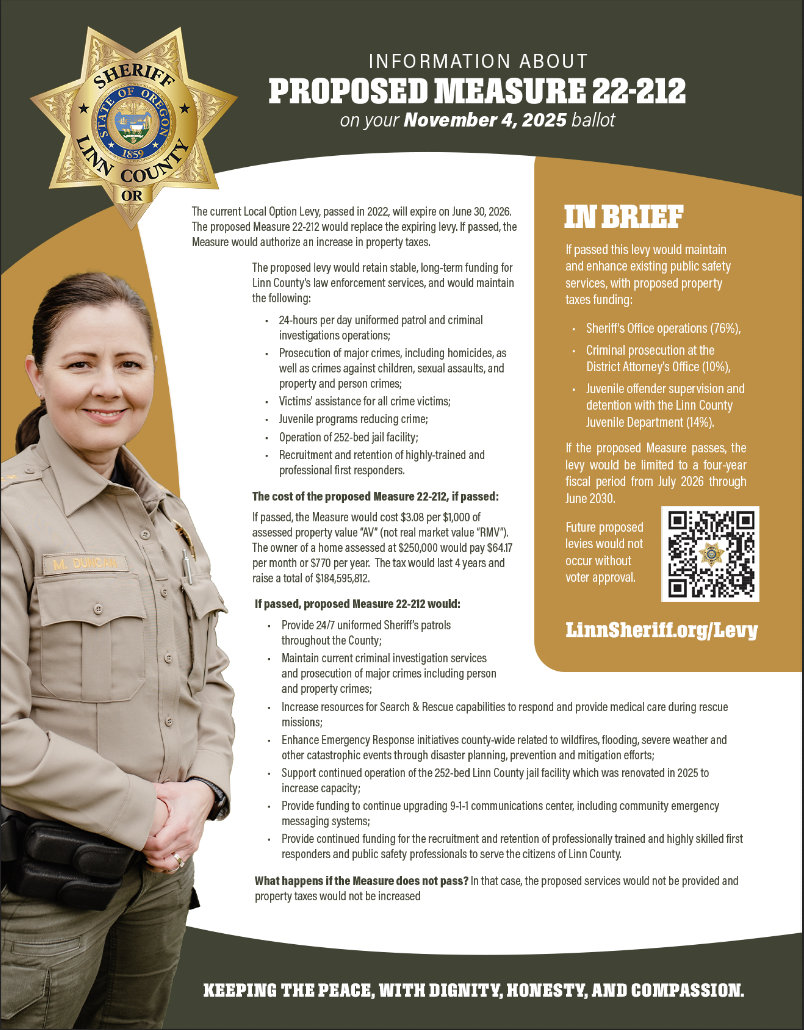
Get in Touch. Get Involved.
Citizens for a Safer Linn County is made up of volunteers from throughout Linn County. Your involvement and support will help us pass the Law Enforcement Levy, and help our law enforcement agencies keep us all safer.